 OUR PICK · SEE IT BY KAYAK
★ 4.98 (81)
3-hour kayak tour
Puerto Río Tranquilo · 3 h · 07:00, 11:00, 15:003 h · ★ 4.98 (81)3h
3 h on the waterinto the low tunnels
From · per person$89per personCheck dates
The rock is ancient, the caves are young: lake water turned a marble shore into the Chapel, Cathedral and Caves.
Updated Nov 2026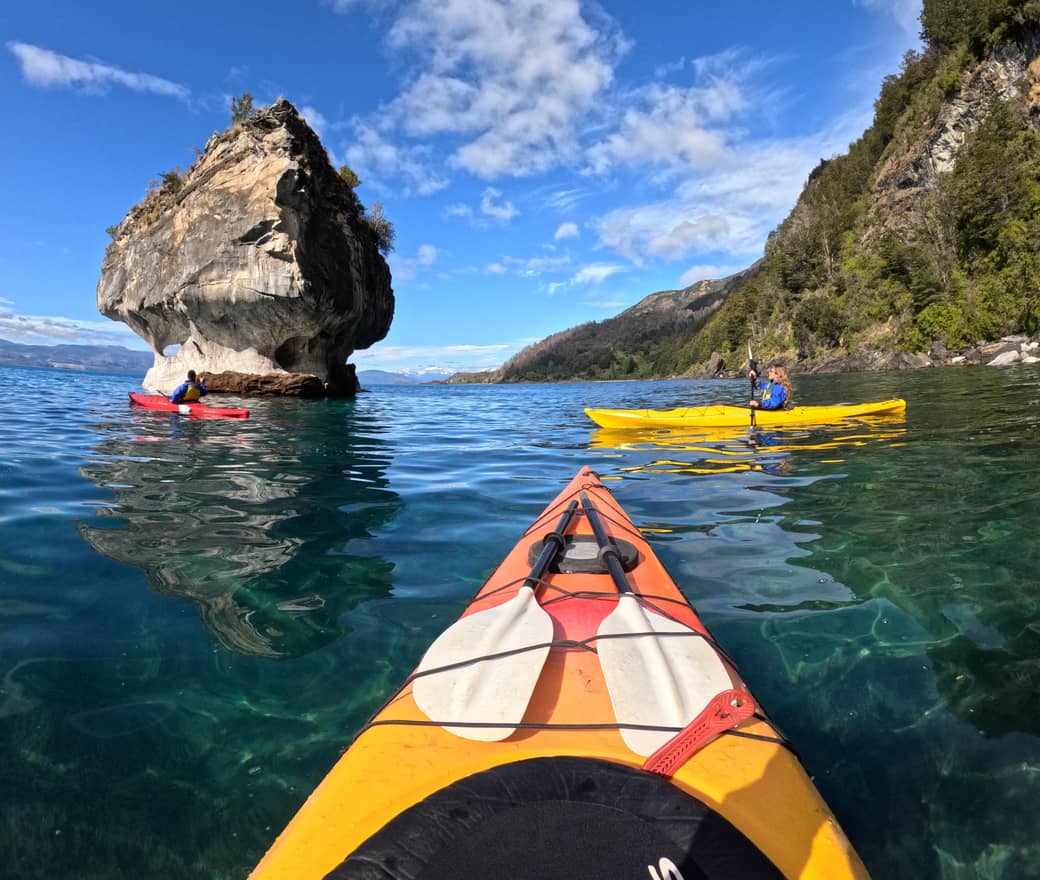 About 300 million years old marbleOUR PICK · SEE IT BY KAYAK
3-hour kayak tour
Puerto Río Tranquilo · 3 h · 07:00, 11:00, 15:003 h · ★ 4.98 (81)The Marble Caves are cut into marble around 300 million years old, but the caves themselves are young: lake water carved them after the last ice age, in less than 15,000 years, according to the Sociedad Geológica de Chile. The turquoise colour comes from glacial rock flour in Lake General Carrera, reflected on the white and grey stone.
How they formed ↓Rock age: about 300 million years (Paleozoic).
Caves carved in under 15,000 years, after the last glaciation.
Lake General Carrera: about 1,850 km², the largest lake in Chile.
Nature Sanctuary since 1994, about 50 hectares.
About 300 m of marble shoreline; the village is about 5.5 km away.
The marble caves were formed by water. Lake General Carrera slowly dissolved the marble along its shore, a process geologists call karst, and carried away whole blocks, leaving the near-vertical cliffs, arches and tunnels you see today. The Sociedad Geológica de Chile dates this carving to after the last glaciation, less than 15,000 years ago.
Marble is limestone changed by heat and pressure deep underground. Where the lake meets the rock, water works into cracks and dissolves the stone unevenly, so softer bands hollow out first. Over thousands of years the hollows joined into tunnels and the tunnels into arches. The process continues: the shoreline is still being shaped every season the lake rises and falls.
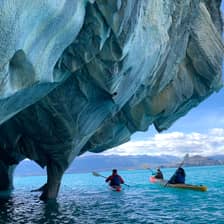
Source · Sociedad Geológica de Chile, “Catedral de Mármol” geosite sheet
The marble is about 300 million years old, from the Paleozoic era, though geologists note that its precise age is not known. The caves are far younger, less than 15,000 years, because they formed only after the glaciers retreated from the lake basin. Figures of about 6,000 years quoted online have no primary source we could find.
Source · Sociedad Geológica de Chile; chile.travel (Jul 2026)
Lake General Carrera is fed by glaciers that grind rock into a fine powder, called rock flour. The particles stay suspended in the water and scatter sunlight, so the lake glows turquoise to deep blue, and the reflected colour paints the white and grey marble in blue swirls. The colour changes with the light and the lake level through the year.
Photographs taken on a bright morning look very different from those on an overcast afternoon: the same walls shift from pale grey to vivid blue. Calm water reflects more evenly, which is one reason guides favour early departures.
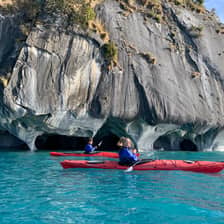
Source · chile.travel · Jul 2026
Three formations make up the sanctuary. The Marble Chapel (Capilla) is a small islet of arches; the Marble Cathedral (Catedral) is the largest block, with tall arches over the water; the Marble Caves (Cuevas) are the tunnels in the shoreline cliff. Boats pass all three; kayaks can slip under the arches in calm water.

The Capilla de Mármol was declared a Santuario de la Naturaleza in 1994 by Chile's Ministry of Education (Decreto Exento 281), protecting about 50 hectares. Visitors may look and pass through on the water but may not enter the interiors of the Chapel and Cathedral. Kayak tours include the sanctuary entrance fee.
Swimming is not banned, but the Chilean Navy cited a group that swam without life jackets in January 2026; the glacier-fed water is cold.
Source · Consejo de Monumentos Nacionales; 24horas.cl (Jan 2026)
Lake General Carrera covers about 1,850 km², making it the largest lake in Chile; it crosses the border into Argentina, where it is called Lago Buenos Aires. The Marble Caves sit on its western shore beside the village of Puerto Río Tranquilo on the Carretera Austral, about 220 km south of Coyhaique.
Getting there takes planning: the nearest airport is Balmaceda, about 190 km away by road. How to get to the Marble Caves →
Source · chile.travel · Jul 2026
Six frames from the tours, from the Chapel islet to the inside of a cave. They show what the facts above describe: smooth, water-polished marble, arches cut at the waterline and the blue swirls that the lake reflects onto the stone. The colour you see on the day depends on the light and the lake level.
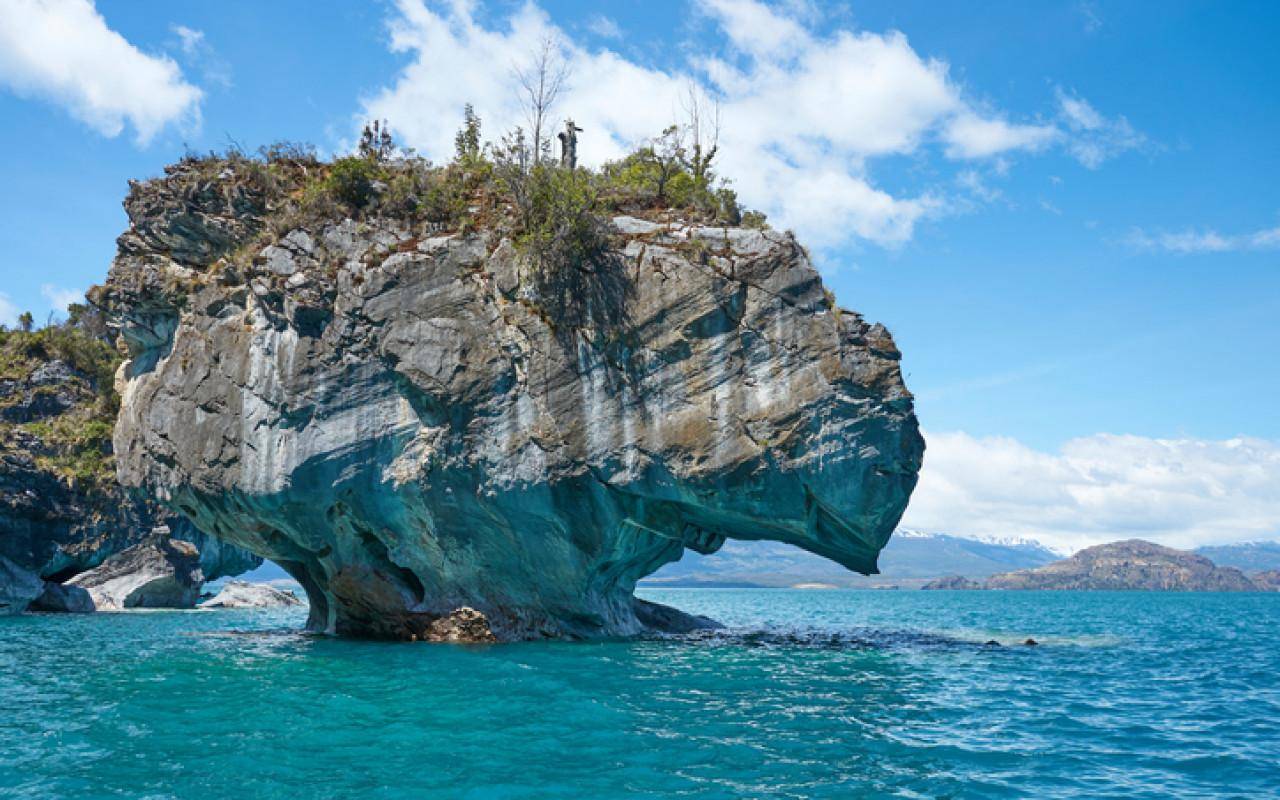 Marble Chapel (Capilla de Mármol) — the small islet of arches every boat passesHow it formed ↑
 Inside the Marble Caves — a vault over turquoise waterHow it formed ↑
 Arched caves on a low marble isletKayak tours →
 A kayak at a cave openingKayak tours →
 Blue swirls on the cave wallsWhy it's blue ↑
 The view from a boatBoat tours →
Photos · GetYourGuide partner galleries
Four things people often get wrong about the Marble Caves, each checked against geological sources and the tour listings. Each card pairs what you may hear with what the sources actually say, short answer first: the rock is ancient but the caves are young, and the blue is in the water.
You can walk into the Marble Chapel.
No. The interiors are protected; you see them from a boat or kayak.
The caves are millions of years old.
The rock is; the caves are not. They formed in under 15,000 years.
The blue comes from the marble.
It comes from the water. Glacial rock flour colours the lake, and the stone reflects it.
Tours leave from Coyhaique.
Every tour starts in Puerto Río Tranquilo, about 220 km south.
“The only experience that allows you to see and enter the formations and caves that lie beyond the cathedral.”
The best way to see the karst arches and blue swirls for yourself is from a kayak, close enough to touch the water-polished stone. The 3-hour tour is the best-rated Marble Caves tour, 4.98 from 81 reviews, with starts at 07:00, 11:00 and 15:00; pick a date to see live availability.
Marble, a metamorphic rock formed from limestone, about 300 million years old. How old ↑
By lake water dissolving the marble along the shore after the last ice age, in less than 15,000 years. How they formed ↑
Glacial rock flour in Lake General Carrera makes the water turquoise, and its reflection colours the marble. Why so blue ↑
On a kayak you pass close enough; do not climb or break the rock in the protected sanctuary. Kayak tours →
Yes. The Capilla de Mármol is a Nature Sanctuary, declared in 1994. The sanctuary ↑
Capillas de Mármol (Marble Chapels), also Catedral de Mármol and Cuevas de Mármol. The three formations ↑
About 1,850 km², the largest lake in Chile. The lake ↑